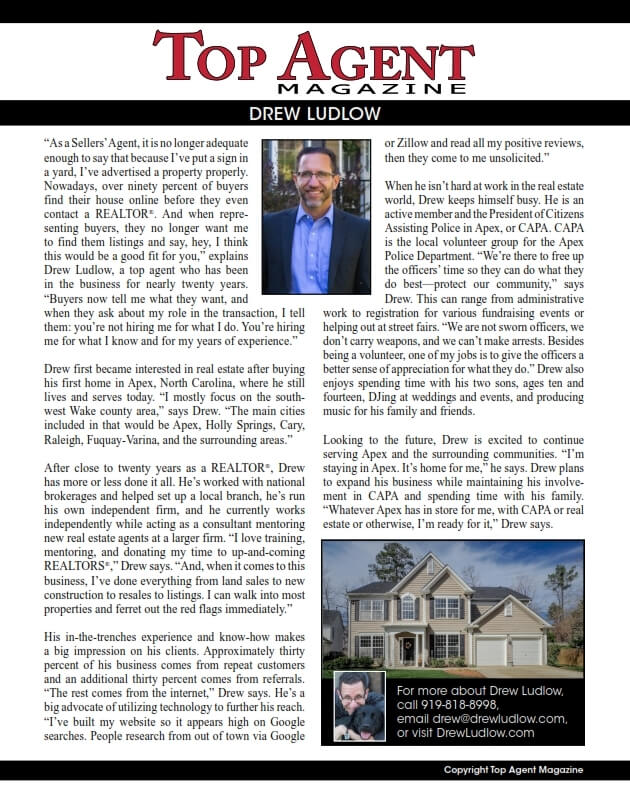
Serving all of Wake County, Drew Ludlow of Ludlow Real Estate Group is a knowledgeable Apex, NC realtor with over two decades of local real estate experience. Dedicated to the best interests of his clients, Drew specializes in residential buyer and seller representation, first-time and move-up homebuyers, foreclosed and short-sale homes in the Triangle area of North Carolina – as well as commercial sales and leasing.
Located in one of the country’s fastest-growing cities, Raleigh, NC real estate is close to excellent restaurants, miles of greenways, and endless entertainment.
Array
(
    [mlsPtID] => 1
    [listingID] => 2523277
    [parentPtID] => 1
    [sqFt] => 3,751
    [acres] => 1.570
    [state] => North Carolina
    [bedrooms] => 4
    [cityName] => Chapel Hill
    [fullBaths] => 3
    [countyName] => Chatham
    [totalBaths] => 4
    [rntLsePrice] => 1250000
    [subdivision] => Chestnut Creek
    [listingPrice] => $1,250,000
    [partialBaths] => 1
    [rntLse] => neither
    [mlsPhotoCount] => 37
    [displayAddress] => y
    [listingAgentID] => R23884
    [listingOfficeID] => 1018
    [priceReductionDate] => 2024-02-07T16:49:49+00:00
    [priceBeforeReduction] => 1300000
    [propStatus] => Active
    [remarksConcat] => This modern farmhouse welcomes you with a large front porch and a beautiful exterior on a 1.57ac lot! Open concept living/dining/kitchen includes a 12' slider door + a library w/ rolling ladder! Walk-in pantry, mudroom/laundry & office. Vaulted Primary BR on 1st floor includes a beautiful spa bath + enormous walk-in closet. 3 more BR and 2 BA, game room, large bonus & a 2nd laundry room on the 2nd floor w/ a walk-in attic. Large screened porch w/ FP provides plenty of entertaining space. Country living close to town. Builder can modify plan to suit buyer's requirements. Other plans can be built on this lot. Other lots are available in Chestnut Creek. *Proposed construction, not yet built. (Pictures are from a similar home Builder has completed in another S/D. Pictures are representative of the style and finish you can expect.) To locate n'hood, use 3600 Jones Ferry Rd., PITTSBORO, NC 27312.
    [zipcode] => 27516
    [idxStatus] => active
    [address] => 34 Chestnut Creek Way
    [streetName] => Chestnut Creek Way
    [streetNumber] => 34
    [latitude] => 35.863325
    [longitude] => -79.165703
    [idxID] => d026
    [idxPropType] => Residential
    [detailsURL] => d026/2523277
    [viewCount] => 58
    [mediaData] => Array
        (
        )

    [ohCount] => 0
    [vtCount] => 0
    [featured] => y
    [restrictSoldListingImages] => -1
    [image] => Array
        (
            [0] => Array
                (
                    [url] => https://cdn.photos.sparkplatform.com/tri/20230922124447294550000000-o.jpg
                    [caption] => Photo 1
                )

            [1] => Array
                (
                    [url] => https://cdn.photos.sparkplatform.com/tri/20230922124449383291000000-o.jpg
                    [caption] => Photo 2
                )

            [2] => Array
                (
                    [url] => https://cdn.photos.sparkplatform.com/tri/20230922124451725931000000-o.jpg
                    [caption] => Photo 3
                )

            [3] => Array
                (
                    [url] => https://cdn.photos.sparkplatform.com/tri/20230922124454179420000000-o.jpg
                    [caption] => Photo 4
                )

            [4] => Array
                (
                    [url] => https://cdn.photos.sparkplatform.com/tri/20230922124456367353000000-o.jpg
                    [caption] => Photo 5
                )

            [5] => Array
                (
                    [url] => https://cdn.photos.sparkplatform.com/tri/20230922124458532921000000-o.jpg
                    [caption] => Photo 6
                )

            [6] => Array
                (
                    [url] => https://cdn.photos.sparkplatform.com/tri/20230922124500722422000000-o.jpg
                    [caption] => Photo 7
                )

            [7] => Array
                (
                    [url] => https://cdn.photos.sparkplatform.com/tri/20230922124502946163000000-o.jpg
                    [caption] => Photo 8
                )

            [8] => Array
                (
                    [url] => https://cdn.photos.sparkplatform.com/tri/20230922124505387896000000-o.jpg
                    [caption] => Photo 9
                )

            [9] => Array
                (
                    [url] => https://cdn.photos.sparkplatform.com/tri/20230922124507537283000000-o.jpg
                    [caption] => Photo 10
                )

            [10] => Array
                (
                    [url] => https://cdn.photos.sparkplatform.com/tri/20230922124509668167000000-o.jpg
                    [caption] => Photo 11
                )

            [11] => Array
                (
                    [url] => https://cdn.photos.sparkplatform.com/tri/20230922124511903871000000-o.jpg
                    [caption] => Photo 12
                )

            [12] => Array
                (
                    [url] => https://cdn.photos.sparkplatform.com/tri/20230922124514425170000000-o.jpg
                    [caption] => Photo 13
                )

            [13] => Array
                (
                    [url] => https://cdn.photos.sparkplatform.com/tri/20230922124516313124000000-o.jpg
                    [caption] => Photo 14
                )

            [14] => Array
                (
                    [url] => https://cdn.photos.sparkplatform.com/tri/20230922124518477933000000-o.jpg
                    [caption] => Photo 15
                )

            [15] => Array
                (
                    [url] => https://cdn.photos.sparkplatform.com/tri/20230922124520652690000000-o.jpg
                    [caption] => Photo 16
                )

            [16] => Array
                (
                    [url] => https://cdn.photos.sparkplatform.com/tri/20230922124522263886000000-o.jpg
                    [caption] => Photo 17
                )

            [17] => Array
                (
                    [url] => https://cdn.photos.sparkplatform.com/tri/20230922124524408746000000-o.jpg
                    [caption] => Photo 18
                )

            [18] => Array
                (
                    [url] => https://cdn.photos.sparkplatform.com/tri/20230922124526591899000000-o.jpg
                    [caption] => Photo 19
                )

            [19] => Array
                (
                    [url] => https://cdn.photos.sparkplatform.com/tri/20230922124527951381000000-o.jpg
                    [caption] => Photo 20
                )

            [20] => Array
                (
                    [url] => https://cdn.photos.sparkplatform.com/tri/20230922124530265217000000-o.jpg
                    [caption] => Photo 21
                )

            [21] => Array
                (
                    [url] => https://cdn.photos.sparkplatform.com/tri/20230922124532390012000000-o.jpg
                    [caption] => Photo 22
                )

            [22] => Array
                (
                    [url] => https://cdn.photos.sparkplatform.com/tri/20230922124534483583000000-o.jpg
                    [caption] => Photo 23
                )

            [23] => Array
                (
                    [url] => https://cdn.photos.sparkplatform.com/tri/20230922124536659414000000-o.jpg
                    [caption] => Photo 24
                )

            [24] => Array
                (
                    [url] => https://cdn.photos.sparkplatform.com/tri/20230922124539507600000000-o.jpg
                    [caption] => Photo 25
                )

            [25] => Array
                (
                    [url] => https://cdn.photos.sparkplatform.com/tri/20230922124541227877000000-o.jpg
                    [caption] => Photo 26
                )

            [26] => Array
                (
                    [url] => https://cdn.photos.sparkplatform.com/tri/20230922124543336202000000-o.jpg
                    [caption] => Photo 27
                )

            [27] => Array
                (
                    [url] => https://cdn.photos.sparkplatform.com/tri/20230922124544431983000000-o.jpg
                    [caption] => Photo 28
                )

            [28] => Array
                (
                    [url] => https://cdn.photos.sparkplatform.com/tri/20230922124546757168000000-o.jpg
                    [caption] => Photo 29
                )

            [29] => Array
                (
                    [url] => https://cdn.photos.sparkplatform.com/tri/20230922124549215531000000-o.jpg
                    [caption] => Photo 30
                )

            [30] => Array
                (
                    [url] => https://cdn.photos.sparkplatform.com/tri/20230922124551435572000000-o.jpg
                    [caption] => Photo 31
                )

            [31] => Array
                (
                    [url] => https://cdn.photos.sparkplatform.com/tri/20230922124553838107000000-o.jpg
                    [caption] => Photo 32
                )

            [32] => Array
                (
                    [url] => https://cdn.photos.sparkplatform.com/tri/20230922124555963547000000-o.jpg
                    [caption] => Photo 33
                )

            [33] => Array
                (
                    [url] => https://cdn.photos.sparkplatform.com/tri/20230922124558110864000000-o.jpg
                    [caption] => Photo 34
                )

            [34] => Array
                (
                    [url] => https://cdn.photos.sparkplatform.com/tri/20230922124559714759000000-o.jpg
                    [caption] => Photo 35
                )

            [35] => Array
                (
                    [url] => https://cdn.photos.sparkplatform.com/tri/20230922124600627861000000-o.jpg
                    [caption] => Photo 36
                )

            [36] => Array
                (
                    [url] => https://cdn.photos.sparkplatform.com/tri/20230922124602928612000000-o.jpg
                    [caption] => Photo 37
                )

            [totalCount] => 37
        )

    [fullDetailsURL] => https://realestate.drewludlow.com/idx/details/listing/d026/2523277/34-Chestnut-Creek-Way-Chapel-Hill-NC-27516
    [userAgentID] =>
)
Array
(
    [mlsPtID] => 1
    [listingID] => 10008245
    [parentPtID] => 1
    [sqFt] => 4,300
    [acres] => 1.930
    [state] => North Carolina
    [bedrooms] => 4
    [cityName] => Chapel Hill
    [fullBaths] => 4
    [countyName] => Chatham
    [totalBaths] => 6
    [rntLsePrice] => 1350000
    [subdivision] => Chestnut Creek
    [listingPrice] => $1,350,000
    [partialBaths] => 2
    [rntLse] => neither
    [mlsPhotoCount] => 15
    [displayAddress] => y
    [listingAgentID] => R23884
    [listingOfficeID] => 1018
    [propStatus] => Active
    [remarksConcat] => This modern Scandinavian-style house plan offers over 4300sf of living space w/ 4 BR, 4 full BA + 2 half baths on almost 2 acres. The open flr plan allows natural light to flood the space, creating a bright atmosphere. Walking into this home, you're welcomed by a beautiful entryway into the 2-story Great Room, open Kitchen and Dining. The light-filled GR provides an area for entertaining, built-in FP, and access to the rear covered patio and covered front porch. The sleek design of the kitch, w/ large walk-in pantry and ample counter space, is perfect for the home chef. A Pocket Office and mudroom/laundry w/ benches and lockers are nearby. The adjacent 3-car garage contributes to additional storage. The primary bedroom is on the right side of the home, complete with two spacious walk-ins and private bath w/ stand alone shower and soaking tub. A half bath and access to secondary bedrooms, baths, loft and bonus are on this side as well. These 3 add'l BR each have their own bathroom and walk-in closet. BR2 is found off a large loft at the top of the stairs. Across a cat-walk that overlooks the Great Room, Bedrooms 3 and 4 lead the way to a large bonus and walk-in attic for plenty of storage. This beautiful home features modern designer finishes, high-end appliances, and energy-saving features just 10 min from downtown Chapel Hill in brand-new Chestnut Creek. To locate n'hood, use 3600 Jones Ferry Rd., PITTSBORO, NC 27312.
*Agents: See Private Remarks.
    [zipcode] => 27516
    [idxStatus] => active
    [address] => 101 Chestnut Creek Way
    [streetName] => Chestnut Creek Way
    [streetNumber] => 101
    [latitude] => 35.86322
    [longitude] => -79.168018
    [idxID] => d026
    [idxPropType] => Residential
    [detailsURL] => d026/10008245
    [viewCount] => 20
    [mediaData] => Array
        (
        )

    [ohCount] => 0
    [vtCount] => 0
    [featured] => y
    [restrictSoldListingImages] => -1
    [image] => Array
        (
            [0] => Array
                (
                    [url] => https://cdn.photos.sparkplatform.com/tri/20240124170734379978000000-o.jpg
                    [caption] => exterior 1
                )

            [1] => Array
                (
                    [url] => https://cdn.photos.sparkplatform.com/tri/20240124170736445454000000-o.jpg
                    [caption] => exterior 2
                )

            [2] => Array
                (
                    [url] => https://cdn.photos.sparkplatform.com/tri/20240124170743424080000000-o.jpg
                    [caption] => left side exterior
                )

            [3] => Array
                (
                    [url] => https://cdn.photos.sparkplatform.com/tri/20240124170738825628000000-o.jpg
                    [caption] => GR 1
                )

            [4] => Array
                (
                    [url] => https://cdn.photos.sparkplatform.com/tri/20240124170741121067000000-o.jpg
                    [caption] => kitchen dining
                )

            [5] => Array
                (
                    [url] => https://cdn.photos.sparkplatform.com/tri/20240124170732296636000000-o.jpg
                    [caption] => dining_office
                )

            [6] => Array
                (
                    [url] => https://cdn.photos.sparkplatform.com/tri/20240124170745639462000000-o.jpg
                    [caption] => office
                )

            [7] => Array
                (
                    [url] => https://cdn.photos.sparkplatform.com/tri/20240124170747774443000000-o.jpg
                    [caption] => primary BR
                )

            [8] => Array
                (
                    [url] => https://cdn.photos.sparkplatform.com/tri/20240124170750202498000000-o.jpg
                    [caption] => primary wet room
                )

            [9] => Array
                (
                    [url] => https://cdn.photos.sparkplatform.com/tri/20240124170928169528000000-o.jpg
                    [caption] => CC09 FIRST FLOOR
                )

            [10] => Array
                (
                    [url] => https://cdn.photos.sparkplatform.com/tri/20240124170933784180000000-o.jpg
                    [caption] => CC09 SECOND FLOOR
                )

            [11] => Array
                (
                    [url] => https://cdn.photos.sparkplatform.com/tri/20240124170950964907000000-o.jpg
                    [caption] => Map 3
                )

            [12] => Array
                (
                    [url] => https://cdn.photos.sparkplatform.com/tri/20240124170943570117000000-o.jpg
                    [caption] => Google Map
                )

            [totalCount] => 13
        )

    [fullDetailsURL] => https://realestate.drewludlow.com/idx/details/listing/d026/10008245/101-Chestnut-Creek-Way-Chapel-Hill-NC-27516
    [userAgentID] =>
)
Array
(
    [mlsPtID] => 1
    [listingID] => 10011075
    [parentPtID] => 1
    [sqFt] => 3,820
    [acres] => 2.480
    [state] => North Carolina
    [bedrooms] => 4
    [cityName] => Chapel Hill
    [fullBaths] => 3
    [countyName] => Chatham
    [totalBaths] => 4
    [rntLsePrice] => 1420000
    [subdivision] => Chestnut Creek
    [listingPrice] => $1,420,000
    [partialBaths] => 1
    [rntLse] => neither
    [mlsPhotoCount] => 57
    [displayAddress] => y
    [listingAgentID] => R23884
    [listingOfficeID] => 1018
    [propStatus] => Active
    [remarksConcat] => This 4-bedroom, 3-car garage modern house plan has a low-profile exterior and high-style interior with its massive windows and designer finishes. A central open-concept core with soaring ceilings and clerestory windows makes the home great for entertaining. A large slider door in the great room connects the space to the large outdoor living area with a fireplace. You can see the great outdoors through huge windows from the gourmet kitchen with its large island, loads of storage, and counter space. Don't miss the wine/coffee bar. A split bedroom layout maximizes your privacy. The large primary suite boasts a spa bath, large walk-in closet, access to a screen porch and proximity to the laundry room. Across the home, two bedrooms and two baths are split by a fourth larger bedroom that can be used as a game, media, or music room instead. This beautiful home features modern finishes, high-end appliances, fiber internet and energy-saving features on a beautiful 2.5-acre lot just 10 minutes from downtown Chapel Hill in brand-new Chestnut Creek. Other lots are available. Builder can modify plans to suit Buyer needs. Pictures are from a similar home Builder has completed in another S/D, but are representative of the style and finish you can expect. (HOME IS NOT CURRENTLY UNDER CONSTRUCTION; ESTIMATED COMPLETION TIME IS 8 MONTHS FROM PERMITTING.) To locate n'hood, use 3600 Jones Ferry Rd., PITTSBORO, NC 27312.
    [zipcode] => 27516
    [idxStatus] => active
    [address] => 31 Meandering Way Court
    [streetName] => Meandering Way Court
    [streetNumber] => 31
    [latitude] => 35.864091
    [longitude] => -79.167038
    [idxID] => d026
    [idxPropType] => Residential
    [detailsURL] => d026/10011075
    [viewCount] => 18
    [mediaData] => Array
        (
        )

    [ohCount] => 0
    [vtCount] => 0
    [featured] => y
    [restrictSoldListingImages] => -1
    [image] => Array
        (
            [0] => Array
                (
                    [url] => https://cdn.photos.sparkplatform.com/tri/20240210203658047584000000-o.jpg
                    [caption] => 49EaglesCrest-02g (1)
                )

            [1] => Array
                (
                    [url] => https://cdn.photos.sparkplatform.com/tri/20240210203839354843000000-o.jpg
                    [caption] => 49EaglesCrest-08g
                )

            [2] => Array
                (
                    [url] => https://cdn.photos.sparkplatform.com/tri/20240210203733805695000000-o.jpg
                    [caption] => 49EaglesCrest-04g
                )

            [3] => Array
                (
                    [url] => https://cdn.photos.sparkplatform.com/tri/20240210203807323264000000-o.jpg
                    [caption] => 49EaglesCrest-06g
                )

            [4] => Array
                (
                    [url] => https://cdn.photos.sparkplatform.com/tri/20240210204034574803000000-o.jpg
                    [caption] => 49EaglesCrest-18g
                )

            [5] => Array
                (
                    [url] => https://cdn.photos.sparkplatform.com/tri/20240210203636087752000000-o.jpg
                    [caption] => 49EaglesCrest-01
                )

            [6] => Array
                (
                    [url] => https://cdn.photos.sparkplatform.com/tri/20240210203645723414000000-o.jpg
                    [caption] => 49EaglesCrest-02
                )

            [7] => Array
                (
                    [url] => https://cdn.photos.sparkplatform.com/tri/20240210203710713006000000-o.jpg
                    [caption] => 49EaglesCrest-03
                )

            [8] => Array
                (
                    [url] => https://cdn.photos.sparkplatform.com/tri/20240210203721549016000000-o.jpg
                    [caption] => 49EaglesCrest-04
                )

            [9] => Array
                (
                    [url] => https://cdn.photos.sparkplatform.com/tri/20240210203747527028000000-o.jpg
                    [caption] => 49EaglesCrest-05
                )

            [10] => Array
                (
                    [url] => https://cdn.photos.sparkplatform.com/tri/20240210203756032844000000-o.jpg
                    [caption] => 49EaglesCrest-06
                )

            [11] => Array
                (
                    [url] => https://cdn.photos.sparkplatform.com/tri/20240210203819520483000000-o.jpg
                    [caption] => 49EaglesCrest-07
                )

            [12] => Array
                (
                    [url] => https://cdn.photos.sparkplatform.com/tri/20240210203828819654000000-o.jpg
                    [caption] => 49EaglesCrest-08
                )

            [13] => Array
                (
                    [url] => https://cdn.photos.sparkplatform.com/tri/20240210203851745585000000-o.jpg
                    [caption] => 49EaglesCrest-09
                )

            [14] => Array
                (
                    [url] => https://cdn.photos.sparkplatform.com/tri/20240210203902652191000000-o.jpg
                    [caption] => 49EaglesCrest-10
                )

            [15] => Array
                (
                    [url] => https://cdn.photos.sparkplatform.com/tri/20240210203913703120000000-o.jpg
                    [caption] => 49EaglesCrest-11
                )

            [16] => Array
                (
                    [url] => https://cdn.photos.sparkplatform.com/tri/20240210203922814328000000-o.jpg
                    [caption] => 49EaglesCrest-12
                )

            [17] => Array
                (
                    [url] => https://cdn.photos.sparkplatform.com/tri/20240210203932336073000000-o.jpg
                    [caption] => 49EaglesCrest-13
                )

            [18] => Array
                (
                    [url] => https://cdn.photos.sparkplatform.com/tri/20240210203943045683000000-o.jpg
                    [caption] => 49EaglesCrest-14
                )

            [19] => Array
                (
                    [url] => https://cdn.photos.sparkplatform.com/tri/20240210203952513429000000-o.jpg
                    [caption] => 49EaglesCrest-15
                )

            [20] => Array
                (
                    [url] => https://cdn.photos.sparkplatform.com/tri/20240210204001949639000000-o.jpg
                    [caption] => 49EaglesCrest-16
                )

            [21] => Array
                (
                    [url] => https://cdn.photos.sparkplatform.com/tri/20240210204011246480000000-o.jpg
                    [caption] => 49EaglesCrest-17
                )

            [22] => Array
                (
                    [url] => https://cdn.photos.sparkplatform.com/tri/20240210204021457537000000-o.jpg
                    [caption] => 49EaglesCrest-18
                )

            [23] => Array
                (
                    [url] => https://cdn.photos.sparkplatform.com/tri/20240210204046567340000000-o.jpg
                    [caption] => 49EaglesCrest-19
                )

            [24] => Array
                (
                    [url] => https://cdn.photos.sparkplatform.com/tri/20240210204056945264000000-o.jpg
                    [caption] => 49EaglesCrest-20
                )

            [25] => Array
                (
                    [url] => https://cdn.photos.sparkplatform.com/tri/20240210204106747901000000-o.jpg
                    [caption] => 49EaglesCrest-21
                )

            [26] => Array
                (
                    [url] => https://cdn.photos.sparkplatform.com/tri/20240210204117105682000000-o.jpg
                    [caption] => 49EaglesCrest-22
                )

            [27] => Array
                (
                    [url] => https://cdn.photos.sparkplatform.com/tri/20240210204127554899000000-o.jpg
                    [caption] => 49EaglesCrest-23
                )

            [28] => Array
                (
                    [url] => https://cdn.photos.sparkplatform.com/tri/20240210204138187483000000-o.jpg
                    [caption] => 49EaglesCrest-24
                )

            [29] => Array
                (
                    [url] => https://cdn.photos.sparkplatform.com/tri/20240210204518375425000000-o.jpg
                    [caption] => 49EaglesCrest-45
                )

            [30] => Array
                (
                    [url] => https://cdn.photos.sparkplatform.com/tri/20240210204148488514000000-o.jpg
                    [caption] => 49EaglesCrest-25
                )

            [31] => Array
                (
                    [url] => https://cdn.photos.sparkplatform.com/tri/20240210204200704033000000-o.jpg
                    [caption] => 49EaglesCrest-26
                )

            [32] => Array
                (
                    [url] => https://cdn.photos.sparkplatform.com/tri/20240210204212334525000000-o.jpg
                    [caption] => 49EaglesCrest-27
                )

            [33] => Array
                (
                    [url] => https://cdn.photos.sparkplatform.com/tri/20240210204223938727000000-o.jpg
                    [caption] => 49EaglesCrest-28
                )

            [34] => Array
                (
                    [url] => https://cdn.photos.sparkplatform.com/tri/20240210204236317685000000-o.jpg
                    [caption] => 49EaglesCrest-29
                )

            [35] => Array
                (
                    [url] => https://cdn.photos.sparkplatform.com/tri/20240210204247429602000000-o.jpg
                    [caption] => 49EaglesCrest-30
                )

            [36] => Array
                (
                    [url] => https://cdn.photos.sparkplatform.com/tri/20240210204257737843000000-o.jpg
                    [caption] => 49EaglesCrest-31
                )

            [37] => Array
                (
                    [url] => https://cdn.photos.sparkplatform.com/tri/20240210204307714838000000-o.jpg
                    [caption] => 49EaglesCrest-32
                )

            [38] => Array
                (
                    [url] => https://cdn.photos.sparkplatform.com/tri/20240210204317499825000000-o.jpg
                    [caption] => 49EaglesCrest-33
                )

            [39] => Array
                (
                    [url] => https://cdn.photos.sparkplatform.com/tri/20240210204328959824000000-o.jpg
                    [caption] => 49EaglesCrest-34
                )

            [40] => Array
                (
                    [url] => https://cdn.photos.sparkplatform.com/tri/20240210204339007842000000-o.jpg
                    [caption] => 49EaglesCrest-35
                )

            [41] => Array
                (
                    [url] => https://cdn.photos.sparkplatform.com/tri/20240210204349350687000000-o.jpg
                    [caption] => 49EaglesCrest-36
                )

            [42] => Array
                (
                    [url] => https://cdn.photos.sparkplatform.com/tri/20240210204359129026000000-o.jpg
                    [caption] => 49EaglesCrest-37
                )

            [43] => Array
                (
                    [url] => https://cdn.photos.sparkplatform.com/tri/20240210204409132251000000-o.jpg
                    [caption] => 49EaglesCrest-38
                )

            [44] => Array
                (
                    [url] => https://cdn.photos.sparkplatform.com/tri/20240210204418732753000000-o.jpg
                    [caption] => 49EaglesCrest-39
                )

            [45] => Array
                (
                    [url] => https://cdn.photos.sparkplatform.com/tri/20240210204428981612000000-o.jpg
                    [caption] => 49EaglesCrest-40
                )

            [46] => Array
                (
                    [url] => https://cdn.photos.sparkplatform.com/tri/20240210204439657978000000-o.jpg
                    [caption] => 49EaglesCrest-41
                )

            [47] => Array
                (
                    [url] => https://cdn.photos.sparkplatform.com/tri/20240210204449320207000000-o.jpg
                    [caption] => 49EaglesCrest-42
                )

            [48] => Array
                (
                    [url] => https://cdn.photos.sparkplatform.com/tri/20240210204459126938000000-o.jpg
                    [caption] => 49EaglesCrest-43
                )

            [49] => Array
                (
                    [url] => https://cdn.photos.sparkplatform.com/tri/20240210204507579488000000-o.jpg
                    [caption] => 49EaglesCrest-44
                )

            [50] => Array
                (
                    [url] => https://cdn.photos.sparkplatform.com/tri/20240210223806611554000000-o.jpg
                    [caption] => FLOOR PLAN_001
                )

            [51] => Array
                (
                    [url] => https://cdn.photos.sparkplatform.com/tri/20240210223801862554000000-o.jpg
                    [caption] => 31 Meandering Way Ct Map
                )

            [52] => Array
                (
                    [url] => https://cdn.photos.sparkplatform.com/tri/20240210223819301308000000-o.jpg
                    [caption] => recorded plat_001
                )

            [53] => Array
                (
                    [url] => https://cdn.photos.sparkplatform.com/tri/20240210223811102920000000-o.jpg
                    [caption] => Google Map
                )

            [totalCount] => 54
        )

    [fullDetailsURL] => https://realestate.drewludlow.com/idx/details/listing/d026/10011075/31-Meandering-Way-Court-Chapel-Hill-NC-27516
    [userAgentID] =>
)
I proudly support the Town of Apex through my volunteer work as the President of CAPA.
Now that we've settled in, we would like to officially thank you for all that you have done for us in finding our house under near impossible specifications, successfully guiding us through writing the offer, and providing us with all the information we needed to comfortably transition into our new home.
Your Fans Forever, Sophie & Thomas Spencer
“
I've had several real estate transactions, and I have to say Drew is"above the rest"! I was very impressed. He explained everything to me throughout the transaction, and was available for my questions and concerns. Drew was there every step of the way. He is very easy to work with. I would highly recommend him to anyone who is buying or selling real estate.
Bob McAdoo
“
Drew was so dedicated and determined to help us find a new home. He was extremely gracious and very knowledgeable in all aspects of real estate. Drew was easy to contact and quick to respond. We would recommend Drew highly to anyone searching for or selling a home. Very professional. Thanks again Drew.-
David & Diana Herbek
“
I am so very happy with my house. Every morning, I thank God for this great blessing. I sometimes still cannot believe that I am now a homeowner. I remember how intimidated I was with the whole process of purchasing a home, me being a first-time buyer and single at that. But you really took care of me and everything went by soooo smoothly. Thank you for all that you have done!
Walt Padgett
“
Selling our house was a breeze with help from Drew! He made the whole process seem effortless because he took care of all the details. It is evident that he is an expert in his field. We recommend him 110%.
Paul & Leslie Peter
“
Mr. Drew Ludlow is a professional, committed and hardworking Realtor who excels for his clients. Mr. Ludlow is knowledgeable, patient and explains all of the facets regarding a short sale. He was always available for questions, gave me a realistic idea on what to expect and followed up throughout the process to ensure my interests were well represented. I thoroughly enjoyed working with Drew and would highly recommend him to anyone.
Collen Connors, Fuquay Varina
“
Thank you so much for helping me sell my home and save my credit too. I never knew what a short sale was before I called you. What a lifesaver!
Ann and Bill McIntosh, Holly Springs
“
Wow! What a process! How did you ever convince my bank to take less that what I owed on that house? I gotta tell you that you did what I thought was impossible. You helped keep a foreclosure off my credit, you sold my home and because of you, I am headed in the right direction now. Thank you!
Antonio Cilia, Raleigh
“
I called 5 other Realtors before I called you, and none of them wanted (or knew how) to help me. You led me through the process, sold my home for less than my total balance, negotiated with the bank like a pro and got that monkey off my back. All I can say is that you are a miracle worker!
Gladys Martin, Cary
“
You fought with the bank and you won! Thank you for helping me short sell my home. I didn't think it was ever going to happen, but you did it. Those buyers got a great deal, but I got an even better deal... my credit was spared! Thanks so much!
Kathryn and Josh Appleton, Apex
Start Your Home Search
Search thousands of homes for sale in Wake County. View pictures and details. Save and share your favorites.
What Buyers Should Know
Be prepared before you jump in. A primer of duties and details that ALL homebuyers should consider.
Instant Home Value
Thinking of selling, but wondering what the value of your home might be? Use this tool to get a home value estimate.
Find a Real Estate Agent
How do you know how is looking out for whom? Who represents YOU?










 Email: drew@drewludlow.com
 Text / Call: 919-818-8998